

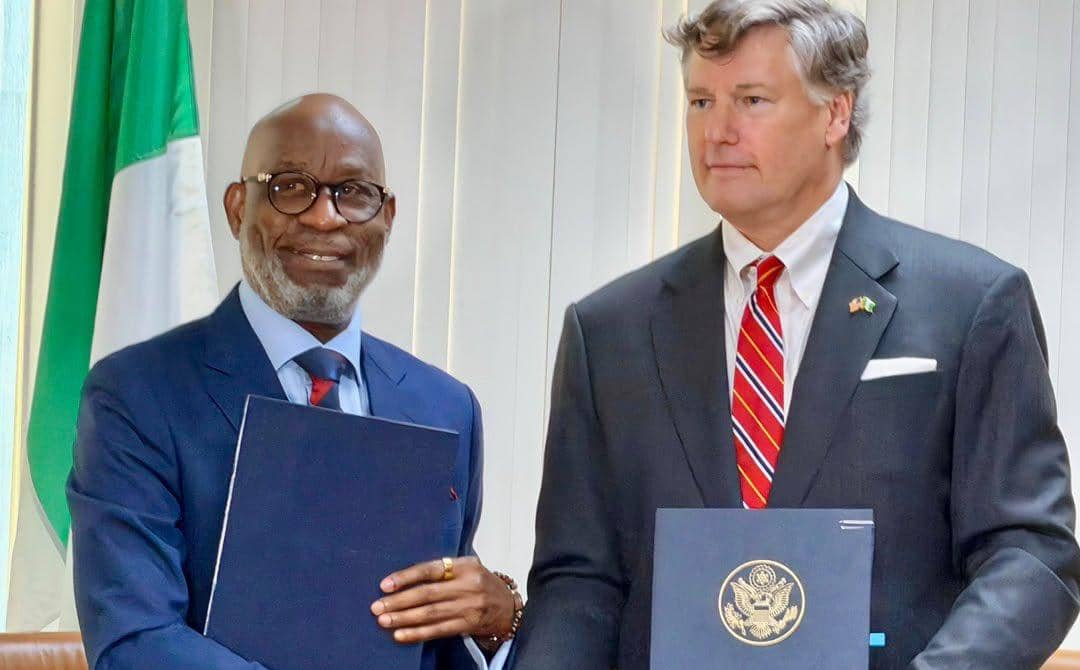
Nigeria and the United States have signed a non-binding strategic framework agreement aimed at unlocking American private-sector capital across Nigeria’s estimated $700 billion solid minerals industry.
The agreement was executed at Nigeria’s Mission House in New York on the sidelines of the 81st United Nations General Assembly (UNGA 81). Minister of Solid Minerals Development, Dele Alake, and U.S. Deputy Secretary of State, Christopher Landau, formally signed and exchanged the bilateral pact.
Key Pillars of the Framework Agreement
The deal establishes a government-backed foundation designed to facilitate direct business-to-business (B2B) investments and technical partnerships. The collaboration covers five critical areas:
- Geological Mapping & Exploration: Joint efforts to produce high-resolution geological data to lower early-stage exploration risks for institutional investors.
- Local Processing & Refining: Mandatory emphasis on in-country value addition rather than exporting unprocessed raw ores.
- Infrastructure Support: Capital alignment to build logistics, power, and transport networks around remote mineral deposits.
- Technical Capacity Building: Skill transfer and technical training for Nigerian engineers, geologists, and local mining services firms.
Local Processing Clause: Ending Raw Material Exports
Minister Dele Alake stressed that the agreement aligns with President Bola Ahmed Tinubu’s economic diversification mandate. He emphasized that Nigeria will no longer operate purely as an extraction site for foreign supply chains:
“Nigeria cannot remain a source of raw materials while others capture most of the value. Our goal is to turn potential into lasting value at home through stronger local processing, quality jobs, and new opportunities for Nigerian businesses.”
Strategic Geopolitics & Critical Minerals Supply Chains
- U.S.–China Competition: The move comes amid growing global competition between Washington and Beijing for critical transition minerals like lithium, tantalum, niobium, and tin—key components in electric vehicle batteries, consumer electronics, and renewable energy storage.
- Diversifying Global Supply: For the United States, securing access to Nigerian mining projects helps diversify critical mineral supply chains. For Nigeria, it opens an alternative channel of Western investment capital alongside existing foreign operators.
Clarification on Deal Value
Market analysts clarify that the $700 billion figure represents the total estimated valuation of Nigeria’s underground mineral wealth—not a direct $700 billion cash injection by the U.S. government. The non-binding framework serves as an institutional bridge for private U.S. investors, commercial banks, and mining giants to enter bankable projects across Nigeria in the coming years.
Public Backlash & Political Fallout
Following the announcement, the deal sparked intense public debate and political pushback back home. Critics and citizens across social media platforms strongly attacked President Tinubu, accusing the administration of handing over control of Nigeria’s strategic mineral reserves to foreign interests without sufficient transparency or local protection guarantees. Opposition figures and commentary online further fueled the backlash, questioning whether the arrangement truly safeguards national sovereignty or primarily serves Washington’s critical mineral ambitions at Nigeria’s expense.