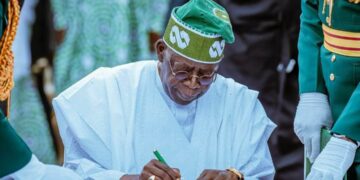


President Bola Ahmed Tinubu has submitted an official request to the National Assembly seeking approval to borrow $20.52 billion and €1.045 billion in new external loans under the 2026–2028 External Borrowing Plan.
The presidential request was formally presented during Tuesday’s plenary session in a letter read on the floor of the upper legislative chamber by Senate President Godswill Akpabio. The massive capital request is intended to bridge critical budget financing gaps and fund key capital infrastructure initiatives across the country over the 2026–2027 fiscal window.
Loan Structure & Sectoral Allocation
According to executive correspondence, the foreign facilities follow comprehensive technical evaluations that identified essential capital projects needed to address Nigeria’s persistent infrastructure deficit.
The funds will be directed into several priority sectors:
- Infrastructure & Power: Expansion of critical national rail links, road networks, grid stability, and energy distribution systems.
- Transportation & Logistics: Urban transit systems, port upgrades, and regional corridor developments.
- Human Capital Development: Funding targeted investments across public healthcare systems and primary/tertiary education facilities.
- Agriculture & Water Resources: Enhancing food security programs, irrigation projects, and municipal water supply infrastructure.
- National Security & Job Creation: Security equipment procurement and job generation schemes aimed at youth empowerment.
Legislative Action & Legislative Committee Review
Upon reading the executive communication, Senate President Godswill Akpabio referred the loan request to the Senate Committee on Local and Foreign Debts for legislative scrutiny:
- Review Timeline: The committee has been given a one-week mandate to examine the terms, borrowing costs, repayment structures, and project attachments before submitting a formal report back to plenary.
- Alignment with Rolling Plans: The Senate leadership noted that the request forms an extension of previously approved rolling external debt frameworks designed to support long-term capital budget execution.
Public Concerns Over Mounting National Debt Profile
The borrowing request has sparked widespread debate across public channels, civic organizations, and social platforms:
- Rising Debt Servicing Pressures: Economic analysts and citizens point to Nigeria’s mounting total public debt stock, which stood at ₦166.79 trillion in Q2 2026, warning that additional multi-billion dollar external debt obligations could exacerbate debt-service-to-revenue ratios.
- Execution & Transparency Demands: Stakeholders have called on the National Assembly to ensure strict oversight, demanding detailed project breakdowns and verifiable delivery timelines to guarantee that borrowed funds yield tangible economic returns rather than expanding fiscal deficits.