


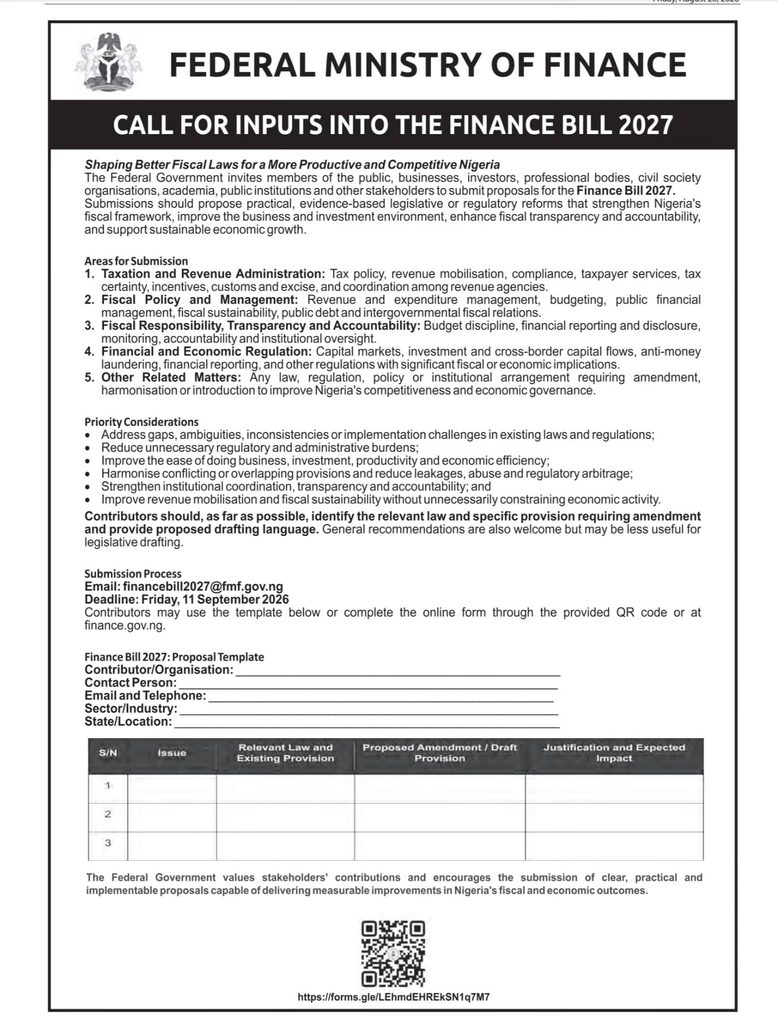
In response to Finance Minister, Taiwo Oyedele’s call for inputs into the Finance Bill 2027, the CEO of Financeblog9ja, Finance Queen, has called for a Taxpayer Transparency Dashboard.
In a comprehensive policy proposal submitted to the Federal Ministry of Finance, Financeblog9ja advocates for a statutory clause in the Finance Bill 2027 to establish a Taxpayer Transparency Dashboard integrated directly into Nigeria’s Single Tax Account framework.
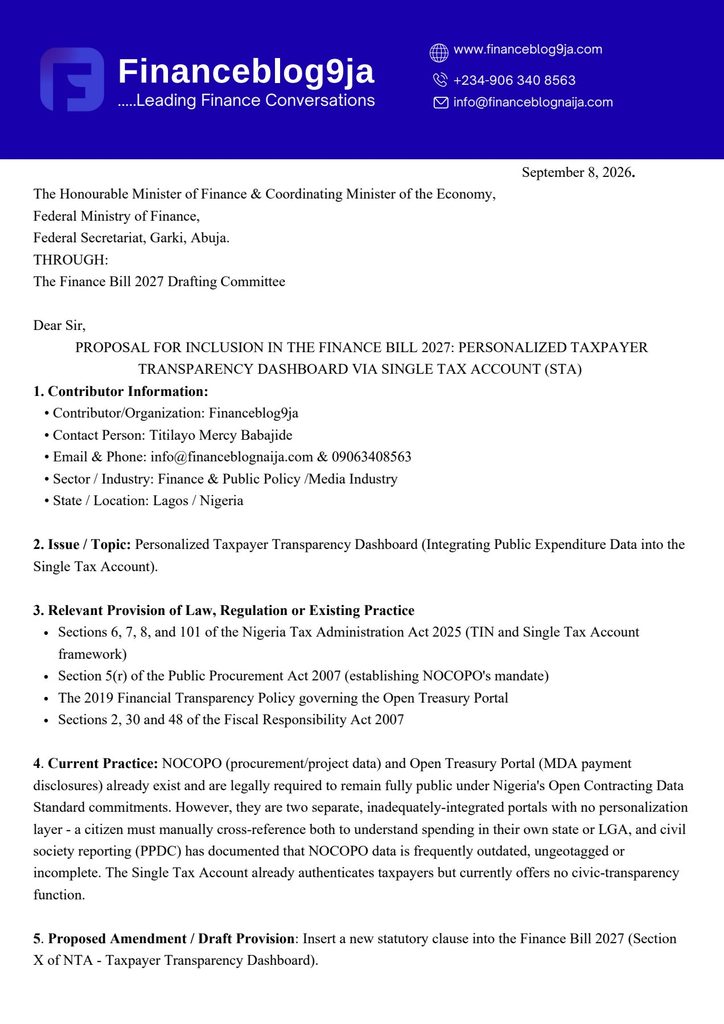

The proposal aims to bridge the gap between tax collection and public spending visibility by combining existing public data systems into a seamless, user-friendly portal for taxpayers.
Current Regulatory Gap and Operational Challenges
While existing frameworks, such as Sections 6, 7, 8, and 101 of the Nigeria Tax Administration Act 2025 and Sections 2, 30, and 48 of the Fiscal Responsibility Act 2007, govern taxpayer authentication and fiscal reporting, public expenditure tracking remains fragmented.
Currently, procurement and spending data reside on separate platforms: the Nigeria Open Contracting Portal (NOCOPO), established under Section 5(r) of the Public Procurement Act 2007, and the Open Treasury Portal, established under the 2019 Financial Transparency Policy. Citizens must manually cross-reference both clunky portals to track spending in their state or Local Government Area (LGA). Furthermore, civil society reports highlight that NOCOPO data is frequently stale, ungeotagged, or incomplete.
Proposed Legislative Provision for Finance Bill 2027
- Unified Data Access: The Federal Ministry of Finance, alongside the Bureau of Public Procurement (BPP) and the Office of the Accountant-General of the Federation (OAGF), will integrate NOCOPO and Open Treasury Portal data into a central dashboard inside the Single Tax Account.
- Geotagged & Filtered Views: Authenticated taxpayers can filter aggregated spending and capital project data by state and LGA without altering the underlying open-data status of existing portals.
- MDA Compliance Benchmarks: The BPP and OAGF will enforce quarterly data-submission benchmarks for Ministries, Departments, and Agencies (MDAs). Non-compliant MDAs will be flagged publicly on the dashboard interface.
- Phased Roadmap: Tracing individual Tax Identification Number (TIN) contributions to specific projects is designated for future phases, ensuring Phase 1 focuses strictly on immediate, technically feasible data integration within Nigeria’s non-earmarked tax architecture.
Strategic Impact and Justification
- Rebuilding Public Trust: Replaces abstract claims about tax usage with localized, visible expenditure data, strengthening tax morale and incentivizing voluntary tax compliance to broaden the tax base.
- Lowers Citizen Effort: Eliminates the need to navigate two separate systems, allowing everyday taxpayers—not just journalists and civil society organizations—to track local clinics, roads, and infrastructure easily.
- Drives Data Quality: Publicly flagging non-compliant MDAs creates natural peer pressure, forcing government agencies to keep spending disclosures current and complete.
- Cost-Effective Integration: Reuses existing government datasets and user authentication layers rather than funding entirely new infrastructure.
Financeblog9ja notes that direct access to expenditure data in the STA balances the social contract and fiscal transparency.